Objective
This sample demonstrates the following MCST Terminal Performance Objectives:
- TPO 7 (primary): Participate in health policy decision-making processes by evaluating primary literature to assist policy makers and prescribers in making well-informed decisions about medical cannabis therapy.
- TPO 10 (primary): Demonstrate a commitment to excellence through continuing professional development and the education and training of patients, healthcare professionals, regulatory bodies, and other relevant stakeholders.
- TPO 9 (secondary): Identify areas for future research related to science, health effects, and policy of medical cannabis, and describe the challenges associated with such research.
Context
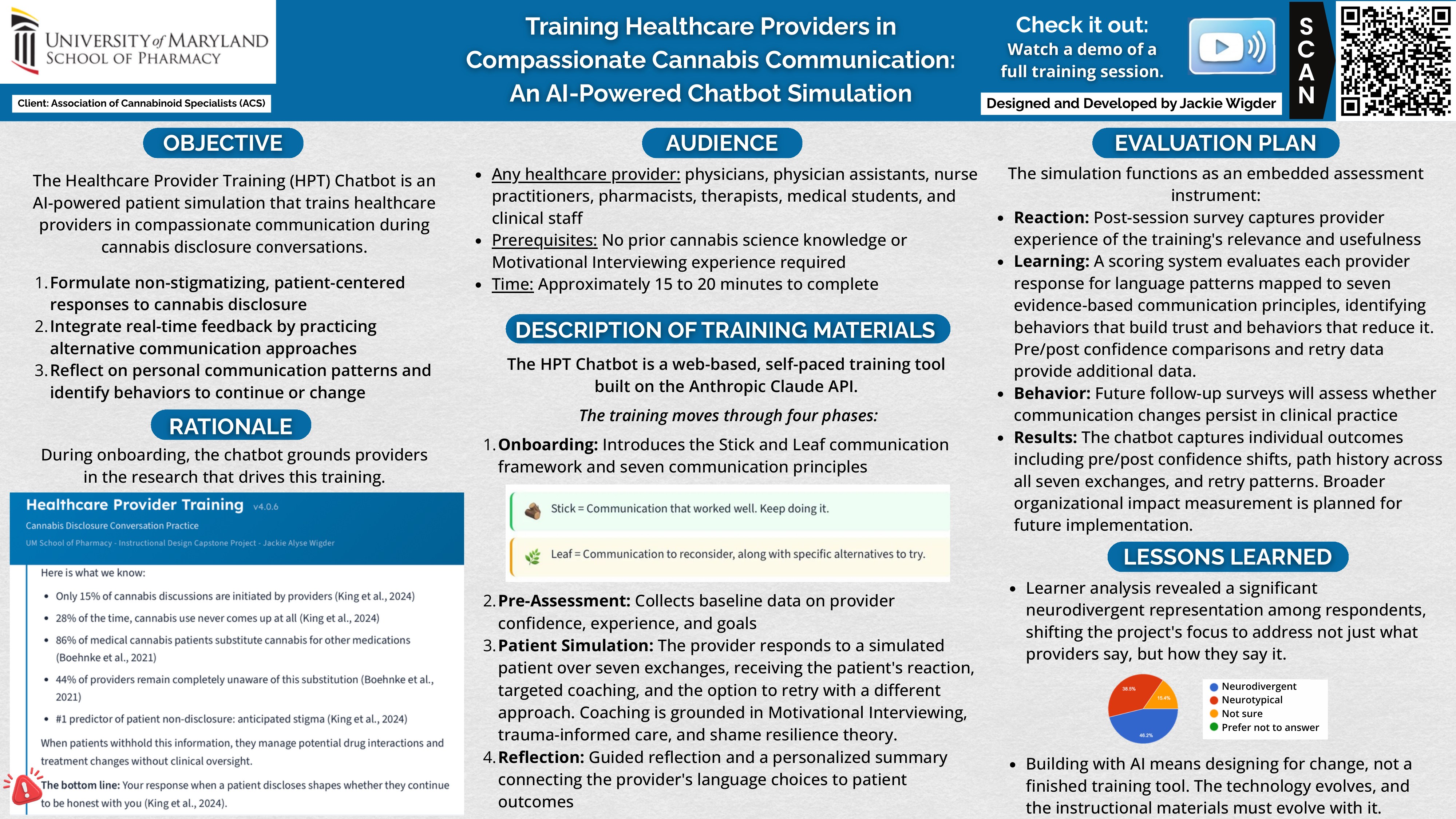
This poster was created for MCST 615: Medical Cannabis Capstone II as the final deliverable of the year-long instructional design project completed across MCST 614 and MCST 615. The project moved through learner analysis, a design plan, development of the training materials, and a Kirkpatrick-based evaluation plan. The final instructional material, the Healthcare Provider Training (HPT) Chatbot, is an AI-powered patient simulation built on the Anthropic Claude API. It takes healthcare providers through seven exchanges of a simulated cannabis disclosure conversation with real-time coaching.
Description and Rationale
Drawing on instructional design methodology, I evaluated primary literature on provider-patient cannabis communication and found a gap in how clinicians handle cannabis disclosure. Through my learner-analysis survey, I confirmed the gap and reoriented the focus from content to delivery. Those results informed my decision to design an approach grounded in Motivational Interviewing, trauma-informed care, and shame resilience theory, centered on trust-building language over information-giving. I built the instructional material with coaching embedded in each exchange. Using Kirkpatrick’s four evaluation levels, I integrated assessment instruments to capture pre-post confidence, language patterns mapped to evidence-based communication principles, and behavior change over time. Survey respondents also showed significant neurodivergent representation, an area that deserves future research.
I chose this sample because it is a functional clinical tool built at the intersection of what I learned and care most about, threading cannabis science, trauma-informed communication, and neurodiversity-affirming design into a single training intervention that healthcare providers can actually use. After graduation, I plan to keep developing it as the research and technology evolve. The poster holds the full arc of that work, from primary literature to patient-ready tool, in a single frame.